Monday, 17 February 2014

In which I discuss disability...


My role as a Special Needs Officer takes me out into the rural communities (known here as “the field”) rooting out children with disabilities.  In theory, the main aim is to get them into an appropriate school but in practice there are many more fundamental problems and hurdles to jump before that can happen.  For instance:

1.    Basic education from Kindergarten through to Junior High School 3 (roughly equivalent to Year 9) has been compulsory and free since 1961.  However, from my admittedly limited experience in the rural north, it is obvious that dozens of children are not attending school.  Perhaps enrolment and attendance are higher in the more affluent south.  The law suggests that parents of non-attenders should be fined but this is never enforced.  There would be a very serious shortage of accommodation and teachers if all these stray children did decide to enroll.  And given that many able bodied children flout the law, getting parents to send a disabled child to school can be quite a challenge!


2.   Disabled children are traditionally regarded as a curse on the family, the outward sign of a misdemeanor or sin, so they are secreted away inside the family compound.  No data is available to illuminate the extent of the problem or where our “clientele” may be; you might think the hospitals would be a good starting point but many of the disabled children are not taken for medical diagnosis or treatment.


3.   There is no systematic approach to finding the information/families we need to help.  Departments don’t work together efficiently to share information.  This is a very oral community where written recording is haphazard.  Computer literacy, even within the Ghana Education Service, is limited, not to mention the lack of access to computers or the internet (how did we ever manage without them/it!).

4.   There is a constant battle to get enough fuel for field work.  Many officers sit in the office with nothing to do, waiting to be allocated a few gallons for a few visits.  As a consequence, I would guess that the more distant communities have never, or very rarely, been visited by the District Special Educational Needs Officer (SPED) so we are barely skimming the tip of the iceberg where disability is concerned.

Some Examples:

Ama lives in the outskirts of Zebilla.  She has no speech.  Her mother has left the family compound so she is cared for by her father, who drinks, and her aunt.  Ama was referred to Zebilla hospital by the SPED, supported by my VSO predecessor, and fortunately her aunt followed through the referral to a diagnosis of paralysis/palsy of the tongue.  Physiotherapy was recommended but that was out of the question given that it would involve a prohibitive 30 km trip to Bawku.

There isn’t a school in Zebilla with any disability specialism but fortunately the Head teacher at Ama’s local primary school is very sympathetic and has accommodated her in the Kindergarten environment.  Socialising with her peer group has been important and definitely speeded her progress in communication; she is making herself understood in many different contexts by gesture - her own sign language and even trying to make sounds.  I am currently trying to organize for (a) the school to set simple targets for progress, like a mini Individual Education Plan (IEP) and (b) a visit to the nearest school for the deaf, for assessment, advice and the possibility of a placement there in September.  It’s a boarding school situated about 50km away.  It would not be the perfect placement given that she has hearing, it’s the speech that is the problem, however, she would be taught sign language.  I don’t really know the character or the intake of the school so I can’t judge yet.  I failed to persuade the Director of Education (who holds the purse strings) that a school INSET delivered by someone from the School for the Deaf and including some basic sign/communication skills would be a good idea.  I am currently in “pestering” mode for her to release the Education Office car so that we can take Ama to get the assessment.  The pestering word should give you an indication of my current success!  However, I am determined.


As well as working with the school you must also work with the family and this is quite an eye opener.  Basically, you turn up on your motorbike in the approximate vicinity of where you think they live (well, clearly I have to rely on the locals for this).  Then you sit down under a shady, evergreen mango tree and wait.  Often there are already a few people there.  At this time of the year a few women sit and sort out seeds, food, rice, children; later on, in the rainy season, they will be out on the farms.  A few men and some of the older folk are there for the company.  On arrival a handy bench is produced for us (they mostly sit on the ground).  By and by, somehow, knowledge of your presence spreads (African drums, witchcraft, miracles…mobile phones or possibly a noisy motorbike revving past) and the community slowly drifts over to the mango tree to join the excitement.  It’s amazing!

And, as you reach the end of the community discussion about the next steps for Ama, another mother gains the confidence to step into the limelight with her disabled child.  This little girl can’t walk.  Two visits later we discover that she has had treatment at two different hospitals, both unsuccessful; and now nothing is being done to help her.  The girl is 4, so should start Kindergarten in September.  So, I have written her a referral to get a current diagnosis and treatment plan so that if necessary (and I think it will be) I can fight for a wheelchair for her (and it may well be a battle!). 


Same time, same place…we have just concluded business with this mother when yet another member of this community produces her disabled son (it’s staggering given the sparsity of dwellings in the vicinity!).  This boy is very small for his 7 years and has that slightly stocky appearance you sometimes find with Down’s Syndrome. Like Ama, he can hear but not speak.  It’s obvious he has limited tongue control and his development seems delayed.  His mother explained to us that when he was a toddler she worried about his lack of speech.  So, he was taken to the local “healer” who slit his tongue (I think the flap underneath) causing profuse bleeding…but no speech.  Call me biased, but I can’t see how this treatment helped!!

So, yet another referral…and all without leaving my shady tree.


This is not an isolated experience.  The same thing happened in another rural community we visited on the opposite side of town.  Here we were seeking out a deaf child we are hoping will attend the School for the Deaf in September.  As we chatted through the procedure for this,  under a shady tree, out came the community to view the man on the motorbike with the “nasara” (white person).  Two more deaf children from two more families were introduced to us and added to our list. 

Surely all this evidence should be enough to convince the district that (a) more systematic work is necessary and (b) there is a need for local provision for disabled people and their families?  Well, actually, not yet, it seems.  We are able to visit only a very few villages and communities.  There must be so many more who really need help to improve the quality of their lives.  But there is no money, no system, little awareness and a huge amount of reticence.

In the next few weeks I hope to get the Special Needs Officer (SPED), Social Welfare Director, Community Health Nurse and a member of the Federation for the Disabled together with a view to firing them with enthusiasm and commitment.  From these few we may be able to set in motion a larger committee whose objectives centre around improving the quality of life for people with disabilities and for their families.  I don’t think it will be easy.  I’m told that the Federation for the Disabled fights amongst itself.  And there is no money.  But who knows what may happen?  In another district they have managed (with some funding and a longer established VSO) to establish a monthly meeting for families with disabled children where they just get together; get support and advice; meet friendly faces; learn that disability is not a shame and…spread the word.  It took a long time to get there…but then, so did that shady mango tree.


Sunday, 2 February 2014

In which I write a missings alphabet...


A selection of the things I miss…

A
Apples: we can buy Golden Delicious but I so miss a little Cox or a Pink Lady!
Architecture: I wouldn’t describe myself as cultured but it would be nice to see some beautiful buildings. 
Advance booking: and some form of timetabling so you don’t have to get up at 3am to wait for a bus that may, or may not, leave at 6am.
B
Baking: I have no oven and I miss both making and eating cakes etc!
Being busy: I have hours at the office where I have nothing to do.  I’ve run out of “odd jobs” and forward planning.  Still, I have completed another phonics workshop with favourable reports J.  I’m so scared I’ll be a dead leg by the time I get back. L
Brown bread:  food may become a common theme!
C
CATHERINE!
Comfy chairs: (of which there are NONE in the whole of Ghana).  We eat off plastic garden furniture
 
and these are what most places have, including schools and bars.  The office has some rickety wooden chairs with torn padded seats which, frankly, make your bum sweat!
Cheese and chocolate: we can get “laughing cow” and when we travelled we ate pizza.  I’m told you can buy a very expensive cheddar in Bolgatanga (but I’d have to brave the tro-tro for that).  You can also buy a small range of chocolate in Bolga but we haven’t…yet!  
 
Braving the tro-tro!
Coffee: real coffee!
Cutlery: that doesn’t bend as soon as you look at it and that matches.
Crockery: that isn’t melamine.
D
Debenhams: where we spend many a happy coffee break!
Dust free environment: I’ll never complain about UK dust again…I will definitely get my lungs tested when I get back - they probably contain half of the Sahara by now!
DVDs:  watching many, many episodes of Star Trek has its limits!
Doors that fit:  we have many doors…not one of them fits.  I even oiled one of them with butter (well, not real butter, you can’t get that).  It worked too – that door doesn’t squeak any more!
 
We tried to block up the holes to keep out the mosquitos!
 
Dishwasher: well, I don’t miss this as much as you might think (given that I
have nothing better to do!)
Driving: in my car (NOT the bike!); driving on the left; following the highway code!; not being so aggressive on the road (perhaps I forget what UK roads are like but we are not constantly blowing our horns to frighten others out of the way!)
E
Equipment: reliable and available resources.  Teaching under a tree with not even a chair is a bit wearing.   The office photocopier is an ancient machine held in the Director’s room and operated by the office clerk; you can’t just use it – well, the paper is restricted for a start.  You even have to ask to use the stapler in the office (and there are often no pins (staples))!
Electricity: the fairly frequent power cuts have not so far been a serious problem ( I think I will need to revise that when the 40 ° temperatures arrive and the fan is not working), it’s more the fact that we are gradually running out of sockets that work.  I nearly blew up the house this morning when the iron plug started smoking at the wall.  Most of the sockets crackle when in use…perhaps that’s why my hair is so curly!
F
Friends and family: normal conversations (well normal for us!) and genuine affection!  Company that’s on the same wave length and gets Paul’s jokes!
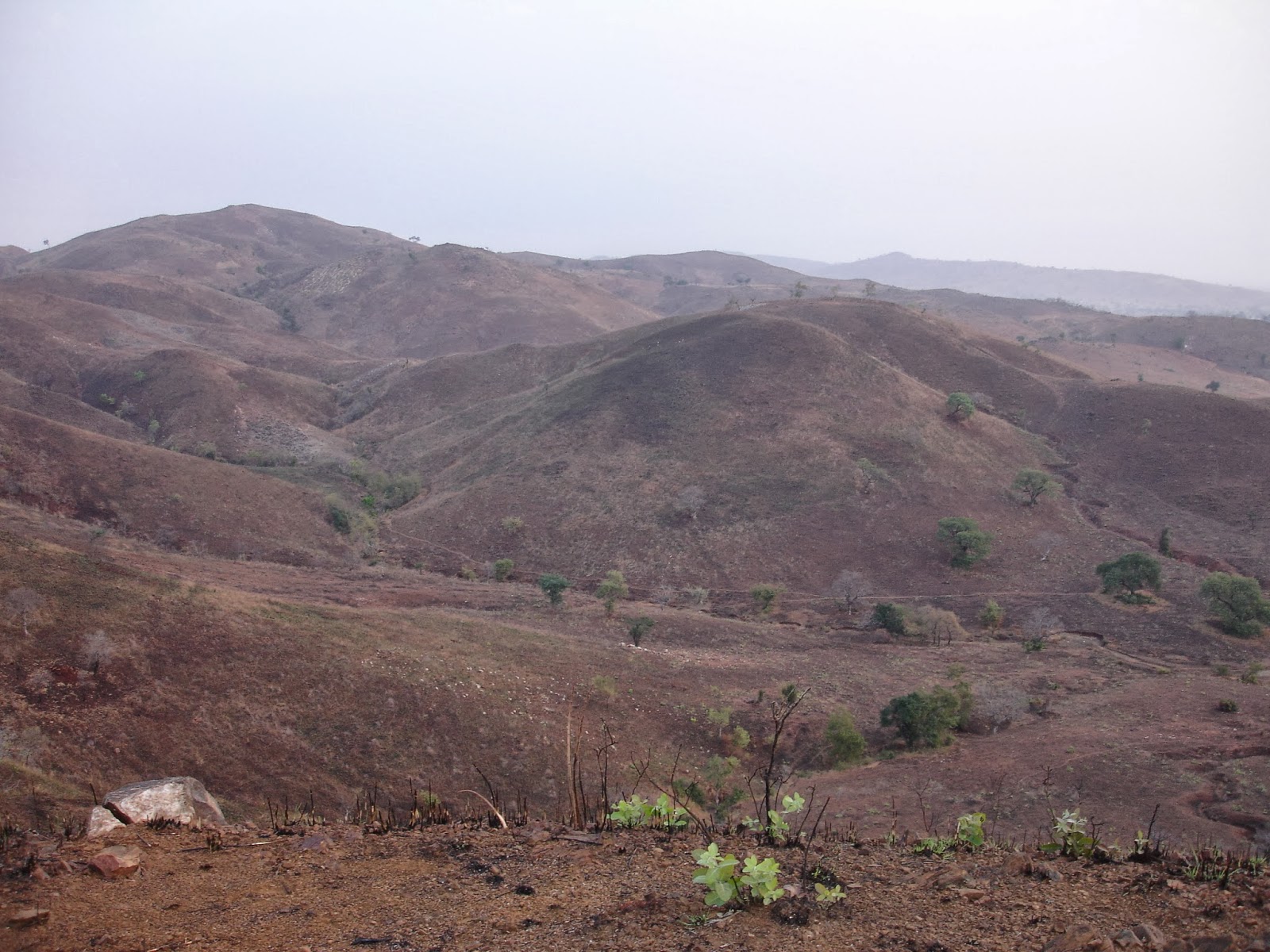
Fields: the typical English green field complete with hedge or dry stone wall.  The rolling countryside.  The hills and mountains and general undulation.  Ah!  There are hills in the distance which create the border between Ghana and Burkino Faso. 
 
The local hills just aren't the same!
 
 We even climbed one or two of them quite recently, getting up at 5.30am to avoid the heat of the day.    
Freezer: none of this going to the crowded, noisy market every 3 days in the boiling heat!
G
Garden: I miss pottering and pruning!
Glass: decent glass to keep out the dust (though I accept that you need the open spaces to let the breeze in and stop you from boiling).  Also to shut out the noise…especially at 4 am when the local churches compete at full volume! 
Windows and breezes in our living room!
H
Hot water: it’s not too bad having to boil water in pans…and cold showers are ok in this climate, but just occasionally hot water on tap would be a treat.
Hairdryer:  my hair has not been cut since September and is totally wild!
I
Internet: it is SO much better than it was when we first arrived but still lacks speed and reliability (it has crashed as I type).
J
JUDITH!
Jogging: (or “trotting” as the locals call it) at the moment we are doing a little circuit at 5.45 am! 2 or 3 days a week.  However, it has been, and will again become, too hot, even at this hour; also, when it rainy season comes again, the nasty mosquitos will be out at this hour and we’d be trotting in the dark through deep puddles. 
K
Karate: we are practicing in our lounge at the weekends for about an hour, again in the slightly cooler early morning (though not quite so early…it is the weekend even if it is hot!) but I’m sure we are getting into bad habits!
L
Language: yes they speak English here but it’s definitely Ghana English.  You hear more of the local languages really; although there are about 80 Ghanaian languages, most people can understand each other.
Luxury: any sort would do!
M
MARGARET!
Meat, milk and mugs: I have not been tempted to buy my meat live to butcher at home, nor yet to frequent the local butcher who has an open stall on the market complete with flies (although I have been pleasantly surprised at how relatively insect free it is here…I may revise this in the wet season when the mosquitos abound).  The choice of milk is dried, soya or evaporated – we use all 3.  We have 2 mugs, of a vulgar sort.  We could buy more…but they would be the same vulgar sort!
Medical care: so far we have only been witnesses to this, thankfully not having needed it ourselves.  However, there are very few doctors in the Upper East (nobody wants to come here) so most treatment is given by health technicians (Paul equates them with first aiders!) and seems to be very inconsistent and is accompanied by lots of injections.  Yuk!
Music: Paul has not listened to anything on his ipod since we arrived and I have only occasionally used my music.  Somehow it feels quite incongruous here.  There is a lot of music in the environment: rap and reggae in the streets – played through enormous, distorting speakers at full volume; church – usually in Kusaal with wannabe young drummers; if you’re lucky you can sometimes pick up some real African rhythms and local beats which are quite nice to listen to for a short while.
Make-up: haven’t worn any of that since our arrival.  I’d look really good with it streaking down my sweaty face!
N
News: I’m not one for news, it generally goes in one ear and out the other, but we’ve heard barely any since our arrival.  I suppose that means I don’t need to make excuses for forgetting it all!  I really enjoyed my mini headlines on Twitter…
O
Oven:
Our cooking arrangements do not include an oven.
P
Planning and organization: none of that to be found here!  Most jobs are completed as a last minute rush because there is no system of forward planning.  The Ghana Education Service bought diaries for the teaching staff this year.  I haven’t yet seen any of them in use.  And they are non-existent in the office!
Privacy: none of that either!  Children stare at us through the non-windows!  People call unexpectedly and you have to drop everything to “greet” them (which can take a while!). 
 
You can see where the children line up to stare at us!
 
Pavements: I am so fed up of sandy toes!  I’m also fed up of dodging bikes and motor bikes coming from all directions on the pavement!  Away from the one main road, of course, there is no pavement, just dirt!
Pointless!: relaxing between jobs with a cuppa in front of the TV.
Q
Quality: there is none…in anything!  Well, actually I need to revise that.  Yesterday I spotted the first articles exhibiting any degree of quality craftsmanship.  They were lavishly polished and ornate.  They looked as if they were made with love and care.  What were they? Coffins.
Quiet:  there is none.  Ghanaians are incredibly loud!
R
Rain: I appreciate that the UK is fed up of this – perhaps you could send some here!
Rug: family joke…how is my rug?
Recipes: I didn’t usually follow them anyway but they were a comfort blanket.  We are producing reasonable results with our guess and hope technique: jam, pancakes, potato cakes, fudge.
 
 
S
Structure: routine, organization – the things I’m good at!
Singing: there is often too much environmental noise to have an effective sing…and also if I sing out then all the neighbours can hear. L And, like I said, we don’t often put on our own music.  However, I did quite a bit of singing during my phonics INSET programmes!  I’m looking forward to a return to choir and a bop around the kitchen.
Supermarkets: I never thought I would say that I missed a supermarket…all that beautifully packaged and uniform food that hasn’t been sitting in the blazing sun all day…pushing round that trolley on a smooth, clean floor with the air-conditioning keeping you cool…no jostling between the aisles.  And even the prospect of a cappuccino at the end.  Bliss!
 
Jostling at the market.
 
T
Teaching:  all that planning and busyness!  Well, perhaps not that aspect of the job!  I miss the interaction with the lovely All Saint’s team and with my class.  I miss the purposeful atmosphere and knowing where and how I fit in.  Most of the time I have no idea what’s going on here!
Toilets: we have a flushing toilet in our house. 
 
Here it is (I won't show you the others)
 
Several compounds close by will share a toilet built equi-distant from their houses.  I have not investigated these.  At the office, there is an open air block set back from the main building, with a partition (male/female).  There is a floor and a pipe which drains into the field.  A more substantial building further afield contains a few holes over the top of a large pit…but nobody in their right mind would “go” there!  It is quite usual to see both adults and children squatting in the field…after which the local pigs queue up for the delicacy!  So, we are now experts at crossing our legs!
U
Underwear: the idea of the well fitting bra barely exists.  Many ladies don’t bother at all and I can understand why – it’s too hot!  There are stalls in the market that sell them; they are all hanging loose.  Finding one with a label could take all day…and just how you are supposed to try them in the middle of the market beats me.  I think that’s why many don’t fit!  So…here’s hoping my underwear lasts!
Understanding: what’s going on, how to find out, where to go for things.  Some kind of written signposting would be so helpful.  Ghanaians can’t say they don’t know, it’s a culture thing, so they make up an answer where required, which means you could be on a wild goose chase!  We’d also like to learn more of the local language but there are no books and no teachers and the locals have no concept of writing down or practicing useful phrases with you!  Very frustrating!
V
Variety: We eat some form of tomato every meal because there are lots of them around all the time.  Otherwise you eat what there is at the market and this depends on the season and which lorries have passed through the town.  Watermelons are at an end; pineapples don’t make it as far as Zebilla; mango season has not yet begun; bananas and oranges are available after a delivery.  It’s the same with the veg.  Onions are in abundance just now.  We tend to eat lots of stews with the vegetables of the day and protein from a tin (meat/fish) or local beans.   Paul has now discovered that a variety of donuts can be purchased for next to nothing and he is trying hard to keep the local cooks in business!
W
Water: we are in the routine of filtering and boiling all our water for consumption and we have a good system for storing it.  Well, I hope it’s good – we haven’t had to test it yet.  Fortunately our polytank of water is filled by a working pump on a regular basis.  Several pumps do not work and have not been fixed for many months.  Many of our neighbours collect water from their nearest bore hole (of which there are many dotted around).  There are problems with our tank in that the stop cock doesn’t work so it has to be turned on and off manually at an underground tap and sometimes we forget with a consequent overflowing and wastage of precious water.  We haven’t yet had a water bill…
 
The trusty water filter!
 
X
 
Y
 
Z


Friday, 17 January 2014

In which I tell Ben's story...


It’s a bit vague…trying to get detailed information from anybody is difficult.  Nevertheless the story is worth telling…

Ben is approximately 13/14 years old; I don’t think anyone knows his age exactly (we came across a case recently where the birth certificate failed to tally with any other official documents e.g. health insurance card…and I don’t think everyone has a birth certificate).

Ben suffers from sickle-cell anaemia and stunted growth.  Until 2012 he also had a very large, disfiguring, abdominal hernia.

From an early age Ben’s development was slow.  His father was convinced that the child was a curse and Ben lived under the constant threat of “not living” (to write that his father wanted to kill him feels extremely brutal though it is nonetheless true).  Ben’s mother feared for his life to the extent that she took the precaution of taking him to live with his grandparents here in Zebilla – a journey of about 10 hours by coach from Kumasi, where they lived in her husband’s family home.

Thereafter, Ben lived, hidden away, with his grandparents.  He did not attend school; he did not really leave this family compound.  Disability and curses are things to be hidden away.

In 2012, the District Special Educational Needs Officer (SPED) from the Ghana Education Service (GES), together with the VSO officer, visited Ben’s village where they happened upon Ben’s grandparents and their secret.  They were extremely shocked when they saw Ben; both his physical and his mental condition were a cause for great concern.  Immediate action was required.  Of course, “immediate” in Ghana can take considerable time!

Arrangements were made and Ben was taken to the hospital in Bolgatanga for assessment and eventually a hernia operation.  This was not an easy task given that neither parents nor grandparents had money to finance this.  There is a National Health Insurance Scheme which covers basics (you have to opt into it and pay a minimal fee which most families now do) but transport costs became a barrier.  In addition, the operation required a medical mesh (see note below) to strengthen the abdominal wall which was not included in the health insurance and cost 150 Ghana cedi.  Determined not to fall at this hurdle, the team at the Education Office pleaded the case at the District Assembly and also arranged a whip round in the Office.  With this support, the operation was completed successfully.

Ben was now in a much better physical condition.  I’m not sure how the stunted growth or sickle cell anaemia were treated but since they are much less visible Ben’s appearance became within the “normal” range.  It was suggested that he might start attending school.  This was an enormous mental challenge for a boy who had spent his life almost as a recluse.  By way of encouragement a bicycle was bought (again through generous donations) and gradually the challenge was faced and overcome.  Ben now attends his local Primary School and is currently in Year 5.

I have never met Ben.  However, his story is widely told and is regarded as a great success story here in Zebilla.  And it is a great success.  My concern is that it seems to be a fairly isolated success.  When will all these children with disabilities be acknowledged and loved?


Medical Mesh

Since our arrival in Ghana we have read about a surgeon who has been very successfully using mosquito nets as the mesh for strengthening the walls around hernias.  This is very cheap and readily available but possibly not yet widely known.  Here in Ghana the “mesh” is the property of the doctor and therefore you buy it from him before the operation. He, of course, will have to buy and keep his own stock of it in readiness.  I’m sure a supply of mosquito nets would be much more easily available.  However, the cynic in me (based on my observations of Ghana), suspects that the doctor might be making a profit from selling the mesh and I wonder whether he would be willing to forfeit this source of additional income?  Let’s hope so!


Saturday, 4 January 2014

In which I share a new Christmas experience...


Travelling

Well…we very nearly didn’t travel at all given that our 2pm bus didn’t arrive until 3.45pm!  You would think I’d be used to “Ghana time” by now but still I get caught out!  Once on board though, the overnight journey to Accra was easy…which was not adequate preparation for the bombardment of the senses on arrival in the centre of the capital city where all systems are in overload and it’s still before 8am!:

The noise: traffic – worn out engines, honking horns; hawkers vying for attention; workmen making their wares at the street sides; stallholders plying their goods; mobile phones singing to be answered; people shouting and generally communicating at full volume.

The smells: those worn out engines again! fumes and petrol; the rancid open drainage system cooking in the sun; street food stalls.

The sights: the traffic jams with hawkers weaving precariously in and out of the queues; people, rainbow-dressed, jostling everywhere; market stalls, crammed with goods, in every available space; half built houses and offices with heaps of sand and bricks piled ready for you to trip into; broken pathways and litter.

You really need your wits about you at all times to avoid being attacked by the many hazards: traffic, people, building sites, open drains…

Fortunately we were sufficiently awake to survive traversing Accra to reach the required bus station for tro-tros to Kokrobite, 30 miles further west.  The next challenge was working out which of the dozens of tros was going the right way.  There are no signs, bus stops, timetables, labels or indeed any form of helpful communication.  Passers by offer conflicting advice.  So, eventually, you opt for the most likely option (possibly the tro which looks least likely to break down) and hop aboard.  Suffice it to say that we did reach our destination relatively unscathed!

The return journey was even more stressful given that we travelled via a different route and nothing was booked, indeed,  we didn’t know if the buses/connections would be running.  Once again there are no websites to browse and telephone information is non-existent/incomprehensible.  I’m not convinced we got the best deal but it’s impossible to tell.  And we did reach Zebilla with only a few more chewed off finger nails!

Travelling in Ghana is difficult (there’s an understatement for you!) for someone who likes to plan and organize; not an activity to be undertaken lightly!

The Destinations

Kokrobite is a resort of two halves.  Firstly, along the shoreline, there are hotels and large villas.  Of the three hotels we visited, the two more successful ones are both managed by Europeans.  Customers flock there for the food, drink, music and entertainment as well as the accommodation.  All tastes are catered for but the majority of the clientele is white (many volunteers!) or more affluent Africans.  The third hotel (where we stayed) was more modest, more run down and much less vibrant (i.e. dead quiet).
                           
                          Our room at the Dream Hotel, Kokrobite

                   
                     Kokrobite Garden Hotel: a pleasant garden retreat

The second half of the resort is the town itself, in stark contrast to the relative comforts of the hotels.  Here the rickety dwellings jostle for space along the open drains and unmade roads.  Despite the squalor, every morning the matriarchs are out in the street organizing the sweeping and tidying of their bits of space, clearing away yesterday’s rubbish and ready for a new day.  By daylight the town is calm and quiet though not deserted.  Come the evening the same streets are alive with street trading, music and relaxing in the local bars.  This is where we sampled our first tilapia fish, fresh from the net, eaten with yam chips!


    Kokrobite town (or village?)

So, despite the general air of poverty the community spirit thrives and it was a pleasure to flit between these two halves!

Cape Coast

Here in Zebilla there is a mixture of housing ranging from the traditional, thatched round buildings spread around a central, shaded courtyard, to a variety of rectangular huts and houses ranging in structure and quality.  Often the dwellings are surrounded by farmland thus generating a feeling of openness and space.  Not so Cape Coast!
 Views of Cape Coast
 
Cape Coast was at one time the capital of the British Gold Coast Colony and retains many old, though now extremely run down, colonial buildings.  Squashed between these and throughout the city are a selection of slum-type dwellings put together using any materials found to hand and stalls with barely walking room between. The atmosphere is busy and bustling with strong competition to get your custom but very little idea about customer service; in one shop the cashier was most disgruntled when we disturbed her TV viewing with our trade!
The city was a little too overbearing for my taste, much preferring watching the fishermen hauling in their huge nets on a wide open beach, keeping time by chanting traditional African rhythms.


                                                                           Sharing out the catch at the end of a hard day's fishing.
Dominating this shoreline stands the Castle, serving as a reminder of the barbarity inflicted by the trade in slaves.  We visited the dank, dark dungeons where up to 1500 slaves might be detained in readiness for shipment (in equally barbaric conditions) to the Caribbean, Brazil and USA/Canada.

From Cape Coast we also visited Kakum National Park with its star attraction of a long canopy walkway.  It calls itself a rain forest though in fact it has a dry season (which a true rain forest would not have).  I was a bit disappointed not to be surrounded by trees full of monkeys but then, any self respecting animal would hide deep inside the forest away from all those interfering, noisy tourists!  It was nevertheless enjoyable as was the nature walk we took afterwards.  It’s a pity there weren’t a few tracks you could walk unaccompanied – a future project perhaps!
 
And finally

The trip was interesting if not wholly enjoyable.  We travelled the length of Ghana, passing from the arid dryness of the north, through the savannah and scrub of the central regions to the green, lush, semi-tropical rain forests of the south.  We witnessed the change in living conditions from the round thatches to the cramped semi-slums.  We have seen the traditional fishing methods of the coastal regions.  We have gained a great wealth of impressions and experiences. 

But, wherever I wander…there’s no place like home!!